Hormone Replacement Therapy in Meridian, Idaho: What to Expect at Our Clinic
If you’ve been considering hormone replacement therapy (HRT), you may have questions about where to begin, what testing is involved, whether insurance will cover your appointments, and how long treatment takes.
At Treasure Valley Pain & Hormones in Meridian, Idaho, we believe hormone care should be accessible, personalized, and provided with the same professionalism and medical oversight you expect from any traditional healthcare clinic.
We are not a subscription-based hormone clinic. We are an established medical practice with experienced healthcare providers, comprehensive evaluations, prescription management, and ongoing follow-up care.
We are contracted with many major insurance plans, helping make hormone replacement therapy more accessible to patients throughout Meridian, Boise, Eagle, Nampa, Kuna, Star, and the surrounding Treasure Valley.
Whether you’re exploring hormone therapy for perimenopause, menopause, or low testosterone, here’s exactly what you can expect from your first appointment through long-term treatment.

Step 1: Schedule Your Initial Hormone Consultation
Your journey begins by scheduling a new patient consultation with one of our experienced hormone specialists.
Our team will collect your insurance information and verify that your coverage is active before your appointment.
We accept many major commercial insurance plans, along with participating Medicare plans.
You can find our current list of accepted insurance plans on our About Us page, under the insurance section.
We also offer self-pay options for patients who prefer not to use insurance or whose plans are out of network.
Our goal is to make the scheduling process straightforward so you can focus on your health.
The FASTEST way to get scheduled is by visiting our website and requesting an appointment online
Step 2: Your First Visit — A Comprehensive Medical Evaluation
Your initial hormone replacement therapy appointment (TELEHEALTH OR IN PERSON) is much more than a quick discussion about lab results.
We take time to understand your symptoms, medical history, previous treatments, and individual health goals.
During your first consultation, your hormone specialist will review:
- Your current symptoms and when they began
- Your complete medical and surgical history
- Current medications, vitamins, and supplements
- Previous hormone treatments and medications
- What has worked for you in the past and what hasn’t
- Menstrual history, perimenopause, or menopause symptoms when relevant
- Sleep quality, energy, mood, and cognitive concerns
- Weight changes, metabolism, and physical health
- Relevant family history and medical risk factors
We also discuss your expectations for treatment and determine whether hormone therapy may be appropriate.
Our philosophy is simple: treat the patient, not just the laboratory numbers.
Hormone symptoms often overlap with thyroid conditions, nutritional deficiencies, metabolic concerns, sleep disorders, and other health issues. Understanding the full picture helps us make informed decisions about your care.
Step 3: Comprehensive Hormone and Metabolic Laboratory Testing
One of the distinguishing features of our approach is our comprehensive evaluation of hormonal and metabolic health.
Rather than focusing on a single hormone, we consider multiple systems that may contribute to your symptoms.
Depending on your medical history, symptoms, and clinical needs, your provider may order testing in the following categories.
self pay Comprehensive Panel (2)
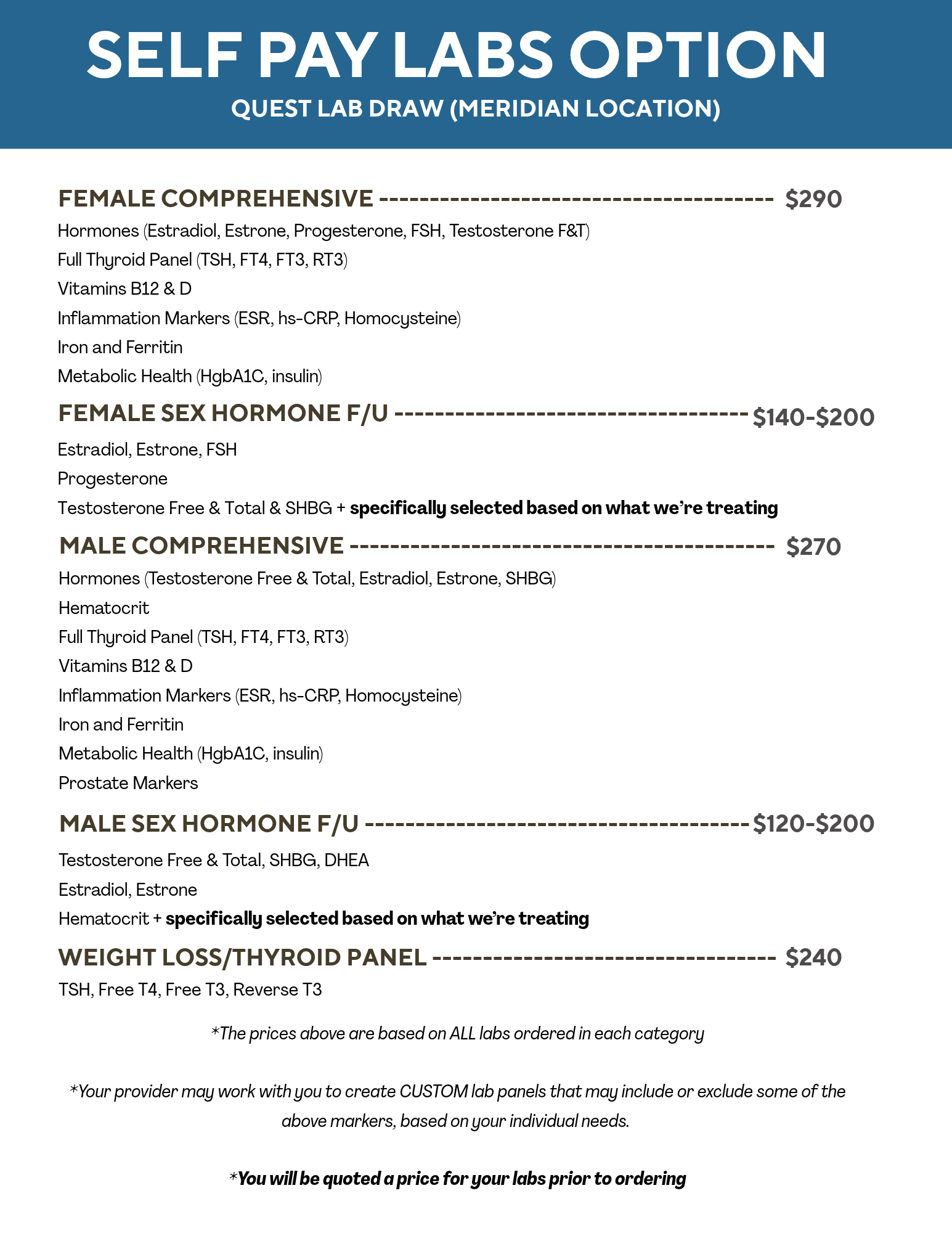
Sex Hormone Testing
Sex hormone evaluation may include:
- Estradiol
- Estrone
- Progesterone
- Follicle-stimulating hormone (FSH)
- Total and free testosterone
Additional testing may be recommended depending on your symptoms, menstrual status, medications, and treatment goals.
These results are interpreted in the context of your medical history, age, and clinical presentation.
Comprehensive Thyroid Evaluation
Thyroid function can influence energy, metabolism, temperature regulation, and many other bodily processes.
Our expanded thyroid testing options include:
- Thyroid-stimulating hormone (TSH)
- Free T4
- Free T3
- Reverse T3
Not every patient needs every thyroid marker. Your provider selects appropriate tests based on clinical findings, and routine reverse T3 testing is not recommended by major thyroid guidelines.
Vitamin and Nutritional Assessment
Certain nutrient deficiencies can contribute to fatigue and other symptoms that overlap with hormonal concerns.
Testing may include:
- Vitamin B12
- Vitamin D
- Iron studies
- Ferritin
Ferritin is particularly useful when evaluating possible iron deficiency, including in patients with fatigue or hair thinning.
Inflammatory and Cardiometabolic Markers
When clinically indicated, we may evaluate:
- Erythrocyte sedimentation rate (ESR)
- High-sensitivity C-reactive protein (hs-CRP)
- Homocysteine
These tests can provide additional information in selected clinical situations, although they are not required for every hormone therapy patient.
Metabolic Health Testing
Metabolic health can influence overall wellness and may contribute to symptoms that patients initially attribute to hormones.
Our testing options include:
- Hemoglobin A1c
- Fasting glucose
- Fasting insulin
Together with your history and other findings, these measurements may help evaluate blood sugar regulation and metabolic concerns.
Additional Specialized Testing
Every patient is different.
Your hormone specialist may recommend other laboratory studies based on your medical history, symptoms, and individual risk factors.
A comprehensive evaluation does not mean every patient automatically receives every test. Our providers use clinical judgment to determine which laboratory studies are appropriate and how the results should guide care.
Step 4: Choose How You Want to Pay for Your Laboratory Testing
We understand that laboratory costs can add up, especially when multiple tests are needed.
That’s why we offer two options for completing your lab work.
Option 1: Self-Pay Laboratory Testing Through Fullscript
Patients can choose our self-pay laboratory option through Fullscript.
Our comprehensive laboratory panel costs approximately $290, depending on the specific tests ordered.
This option provides upfront pricing and may be convenient for patients with high deductibles or those who prefer not to bill insurance for laboratory testing.
Option 2: Use Your Health Insurance for Laboratory Testing
If you prefer to use insurance, we can send your laboratory orders to a lab of your choice.
The laboratory will bill your insurance according to your plan’s benefits and medical necessity requirements.
Coverage, deductibles, and out-of-pocket expenses vary.
How to Prepare for Your Lab Appointment
For our standard comprehensive laboratory evaluation, we generally ask patients to arrive fasting.
Our team will provide instructions about fasting duration, the best timing for testing, and whether any medications or supplements need special consideration.
Some hormone measurements may also require particular timing based on your menstrual cycle or medication schedule.
Step 5: Return in Approximately 2–3 Weeks for Your Lab Review
Once your laboratory results are available, you’ll return for a follow-up appointment, generally about two to three weeks after your initial consultation.
This is where we connect your symptoms, medical history, and laboratory findings.
Your provider will review the results with you, explain which findings are clinically significant, and discuss the possible reasons for your symptoms.
We believe patients should understand their laboratory results rather than simply being handed a prescription.
Creating Your Personalized Hormone Treatment Plan
If hormone replacement therapy is appropriate, we’ll discuss a treatment plan based on your individual needs.
Depending on your clinical situation, treatment may include:
- Estrogen therapy for appropriate menopause-related indications
- Progesterone or progestogen therapy when indicated
- Testosterone replacement therapy for men with confirmed hypogonadism
- Other hormone-related treatment options when clinically appropriate
- Evaluation and management of relevant thyroid or metabolic conditions
- Nutritional and lifestyle recommendations
- Evidence-informed supplement recommendations when appropriate
Not everyone needs hormone replacement therapy. In some cases, laboratory testing and medical evaluation identify other health concerns that should be addressed first.
Our goal is to recommend treatment that makes sense for your symptoms, medical history, and long-term health.
Step 6: Prescriptions, Pharmacies, and Keeping Treatment Affordable
One of the most common concerns patients have about hormone replacement therapy is cost.
At Treasure Valley Pain & Hormones, we work to make treatment as affordable and practical as possible.
We Prioritize Insurance-Covered Medications
Whenever an appropriate medication is available through a commercial pharmacy and covered by your insurance, we prioritize that option.
Prescriptions can be sent to your preferred retail pharmacy.
Compounding Pharmacies When Appropriate
In certain situations, a compounded medication may be considered when an approved commercial product cannot meet a patient’s specific medical needs.
Compounded medications are generally not covered by insurance and are not FDA-approved products.
We discuss the available options, costs, and relevant considerations before selecting a treatment.
Supplements Through Fullscripts
When supplements are clinically appropriate, we may recommend products through our Fullscript platform.
Fullscript provides access to practitioner-selected supplement brands, allowing patients to review recommended products and order them online.
Supplements are optional and do not replace necessary prescription treatment or medical evaluation.
Our priority is not to sell expensive treatment packages. It’s to help patients access appropriate medical care while keeping unnecessary costs down.
Step 7: Begin Treatment and Monitor Your Progress
After your treatment plan is established, you’ll begin the recommended medications or other interventions.
Hormone therapy is not a one-size-fits-all process.
Different patients respond at different rates, and some medications require adjustments based on symptoms, laboratory findings, side effects, and safety monitoring.
During the first several months, we assess:
- Changes in your original symptoms
- Medication tolerance and possible side effects
- Sleep, energy, and overall well-being
- Relevant hormone levels when testing is indicated
- Treatment safety and ongoing medical needs
We generally plan a follow-up in approximately two to three months, with selected laboratory testing based on your treatment.
Certain therapies, including testosterone replacement, may require specific earlier or additional monitoring.
Step 8: Follow-Up Visits Every 2–3 Months While Adjusting Treatment
Our approach is designed to provide continuity of care rather than leaving patients to manage their hormone therapy alone.
During the initial treatment period, many patients return approximately every two to three months.
These appointments allow us to evaluate your progress and determine whether adjustments are necessary.
We may modify medication doses, review new symptoms, address side effects, or investigate other contributing medical concerns.
We also review selected laboratory markers when appropriate.
The goal is to find a treatment regimen that provides meaningful symptom improvement while maintaining safe, clinically appropriate hormone levels.
We do not pursue a single laboratory target for every patient, and we avoid unnecessarily increasing hormone doses simply to achieve higher numbers.
Step 9: Long-Term Maintenance Visits Every 6–12 Months
Once your treatment is stable, your symptoms have improved, and your medication regimen is working well, follow-up appointments generally become less frequent.
Many established patients return every six to twelve months, depending on their medications, medical history, and monitoring requirements.
Laboratory testing is also individualized, often occurring every six to twelve months when appropriate.
Some medications or medical conditions require more frequent monitoring.
Long-term hormone management is an ongoing partnership.
Our goal is to help patients maintain symptom improvement, review treatment risks and benefits, and adjust care as their needs change.
Does Insurance Cover Hormone Replacement Therapy in Meridian, Idaho?
One of the biggest differences between our clinic and many online hormone programs is our traditional insurance-based medical model.
Treasure Valley Pain & Hormones is contracted with many major health insurance plans.
Our new patient consultations, medically necessary follow-up appointments, and ongoing care are billed to insurance when eligible.
Your actual coverage depends on your specific plan, medical diagnosis, deductible, copay, and other benefits.
Medications and laboratory testing may have separate coverage requirements.
We verify active insurance eligibility before scheduling and can help explain available payment options. Eligibility verification does not guarantee that every service will be covered.
For the most up-to-date list of participating insurance plans, visit our About Us page and scroll to the insurance section.
Hormone Replacement Therapy for Women and Men
Our hormone specialists provide individualized evaluations for both women’s and men’s hormone health.
Women’s Hormone Replacement Therapy
We evaluate concerns related to perimenopause, menopause, and other clinically appropriate hormone conditions.
Common reasons patients seek an evaluation include hot flashes, night sweats, sleep changes, vaginal symptoms, and other concerns that may occur during the menopause transition.
Treatment decisions are based on symptoms, medical history, risks, and patient preferences.
Men’s Testosterone Replacement Therapy
We also evaluate men experiencing symptoms that may be associated with testosterone deficiency.
Diagnosis requires appropriate clinical assessment and confirmatory testing rather than symptoms alone.
When testosterone replacement therapy is indicated, our providers discuss treatment options, fertility considerations, medication monitoring, and long-term follow-up.
Frequently Asked Questions About Hormone Replacement Therapy
Do I need to have hormone labs done before my first appointment?
No. We generally recommend beginning with your medical consultation so your provider can determine which laboratory tests are appropriate for your specific situation.
Does Treasure Valley Pain & Hormones accept insurance?
Yes. We are contracted with many major insurance plans and offer traditional medical visits billed to insurance when eligible. Visit our About Us page for the current list of participating plans.
How much does the comprehensive hormone lab panel cost?
Our self-pay laboratory option through Fullscript is approximately $290 for the comprehensive panel. The final cost depends on the tests ordered. You may also choose to use an outside laboratory that bills your insurance.
Do I need to fast for hormone blood work?
For our comprehensive panel, we generally request fasting because metabolic testing may be included. Our staff will provide instructions based on your specific orders.
How long does it take to start hormone replacement therapy?
Most patients begin with a new patient consultation, complete their laboratory testing, and return approximately two to three weeks later to review results and discuss treatment options.
If treatment is appropriate, prescriptions can be discussed during that follow-up.
How often will I need follow-up appointments?
During treatment adjustments, follow-ups are commonly scheduled every two to three months. Once treatment is stable, visits may be spaced to every six to twelve months, depending on the medications and clinical monitoring required.
Do I have to use a compounding pharmacy?
No. We prioritize appropriate commercially available medications and insurance-covered options whenever possible. Compounded medications are considered only when clinically appropriate.
Is hormone replacement therapy a lifelong commitment?
Not necessarily. Treatment duration depends on the medical indication, individual response, risks, and changing health needs. Your provider will periodically reassess whether continuing treatment is appropriate.
Start Hormone Replacement Therapy in Meridian, Idaho
If you’re looking for a hormone replacement therapy clinic in Meridian or Boise that accepts insurance, Treasure Valley Pain & Hormones offers a personalized, medically supervised approach.
From your first consultation and comprehensive evaluation to prescription management and long-term follow-up care, our team is here to help you navigate the process.
We proudly serve patients throughout Meridian, Boise, Eagle, Nampa, Kuna, Star, Caldwell, and the surrounding Treasure Valley.
Treasure Valley Pain & Hormones
2102 W Everest Ln, Suite 100
Meridian, ID 83646
Call or text: 208-505-4744
Website: www.tvpaincenter.com
Ready to get started? Request your new patient hormone consultation today.
This article is intended for educational purposes. Laboratory testing, insurance coverage, treatment recommendations, and follow-up intervals are individualized according to medical necessity and clinical judgment.